
Cinema, spoken theatre and musical theatre: three different professions, three different biomechanics
- Valentina Carlile DO

- 2 hours ago
- 2 min read
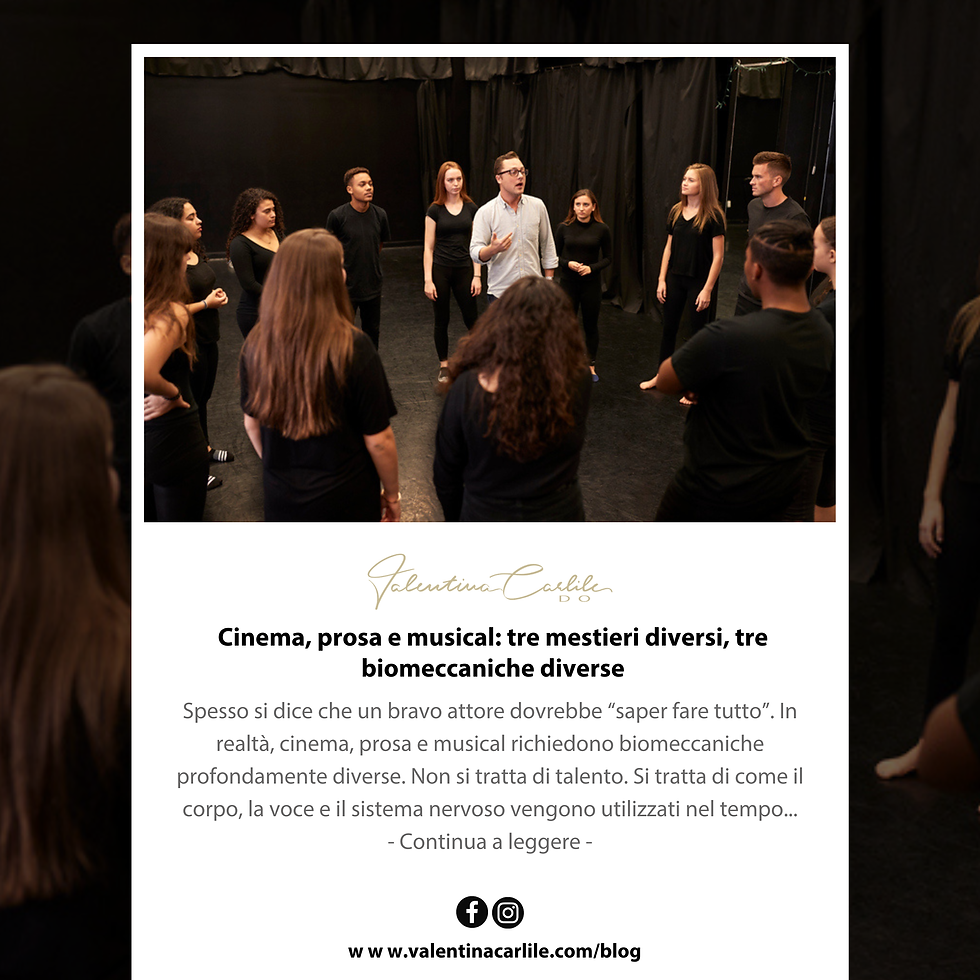
It is often said that a good actor should “know how to do everything”. In reality, cinema, spoken theatre and musical theatre require profoundly different biomechanics.
It is not about talent. It is about how the body, the voice and the nervous system are used over time.
Those who ignore these differences risk early fatigue, drops in quality, injuries and unsustainable casting choices.
At first glance, cinema, spoken theatre and musical theatre share voice, body, emotion and stage presence.
Biomechanically, however, the way these elements are organized and stressed changes radically.
In cinema, the body must disappear. The camera amplifies everything: micro-movements, micro-tensions, micro-compensations.
Main biomechanical requirements
Neutral and contained posture
Fine tonic control
Silent breathing
Minimal voice, not projected
Ability to repeat without stiffening
The load is fragmented, repetitive, often asymmetrical and neurologically demanding.
The main risk is deep rigidity caused by over-control. A typical mistake is using “stage” biomechanics in front of the camera.
In cinema, the best biomechanics is the one that is not seen.
In spoken theatre, on the other hand, the body cannot disappear. It must support the text, inhabit the space, sustain scenic continuity and transmit meaning all the way to the last row.
Main biomechanical requirements
Organized and lasting posture
Continuous and structured breathing
Resistant and transmissive voice
Constant bodily presence
Ability to sustain emotion over time
The load is continuous, linear, vocal and postural, less fragmented, but longer. The main risk is progressive collapse or stiffening. A typical mistake is using a “contained” voice that does not travel through the space.
In theatre, biomechanics carries the word.
In musical theatre, the body can neither disappear nor focus on only one task. It must sing, move, act, coordinate everything together, and do so under load and fatigue.
Main biomechanical requirements
Adaptive breathing
Dynamic posture
Hybrid and resistant voice
Neuromotor coordination
Effective recovery
The load is triple — voice, movement, cognition — intermittent, emotionally and physically intense, repeated many times a week. The main risk is the development of cumulative compensations. A typical mistake is training voice, body and acting separately.
In musical theatre, biomechanics either integrates everything or collapses.
Many problems arise when a theatre actor approaches cinema without adapting the body, when a film actor steps on stage without reorganizing voice and posture, or when a musical performer uses strategies that are only valid in the rehearsal room.
Biomechanics is not universal. It is specific to the context.
For performers, understanding the context protects the body, improves quality and increases professional longevity.
For productions, more sustainable casts mean fewer forced stops, greater reliability and better quality over time.
Cinema, spoken theatre and musical theatre are not only different artistic styles. They are different biomechanical demands.
Talent remains fundamental, but it is the organization of the body–voice–nervous system that allows an actor to move through different contexts without wearing themselves out.
Valentina Carlile - Osteopath specializing in Osteopathy for Voice and Speech Disorders since 2002. For information and bookings, visit the Contact page.


Comments